CSRD - Reading time: 9 Min

The EU Taxonomy Regulation defines clear environmental targets for companies and helps them to implement them. With this regulation, the EU aims to make a significant contribution to environmental protection and increase transparency with regard to environmental investments. The regulation was introduced to set uniform standards for environmentally friendly investments and to promote a sustainable economy. Companies must already prepare for this now, as the EU taxonomy will be mandatory for all relevant players in the European Union. It is becoming increasingly important to report on how companies are achieving their environmental goals and what they are doing to achieve them. In this article, we explain the regulation and explain which companies are affected by it and when they are obliged to report. In this blog post, we would like to provide an overview of the taxonomy.
The EU taxonomy is a classification system that defines which economic activities are considered environmentally sustainable - a central element of the EU sustainability strategy.
It is intended to channel capital flows into sustainable investments, prevent greenwashing and create a uniform basis for ESG assessments and reporting.
It affects large companies that fall under the CSRD, as well as financial market participants and states in the design of sustainable financial products.
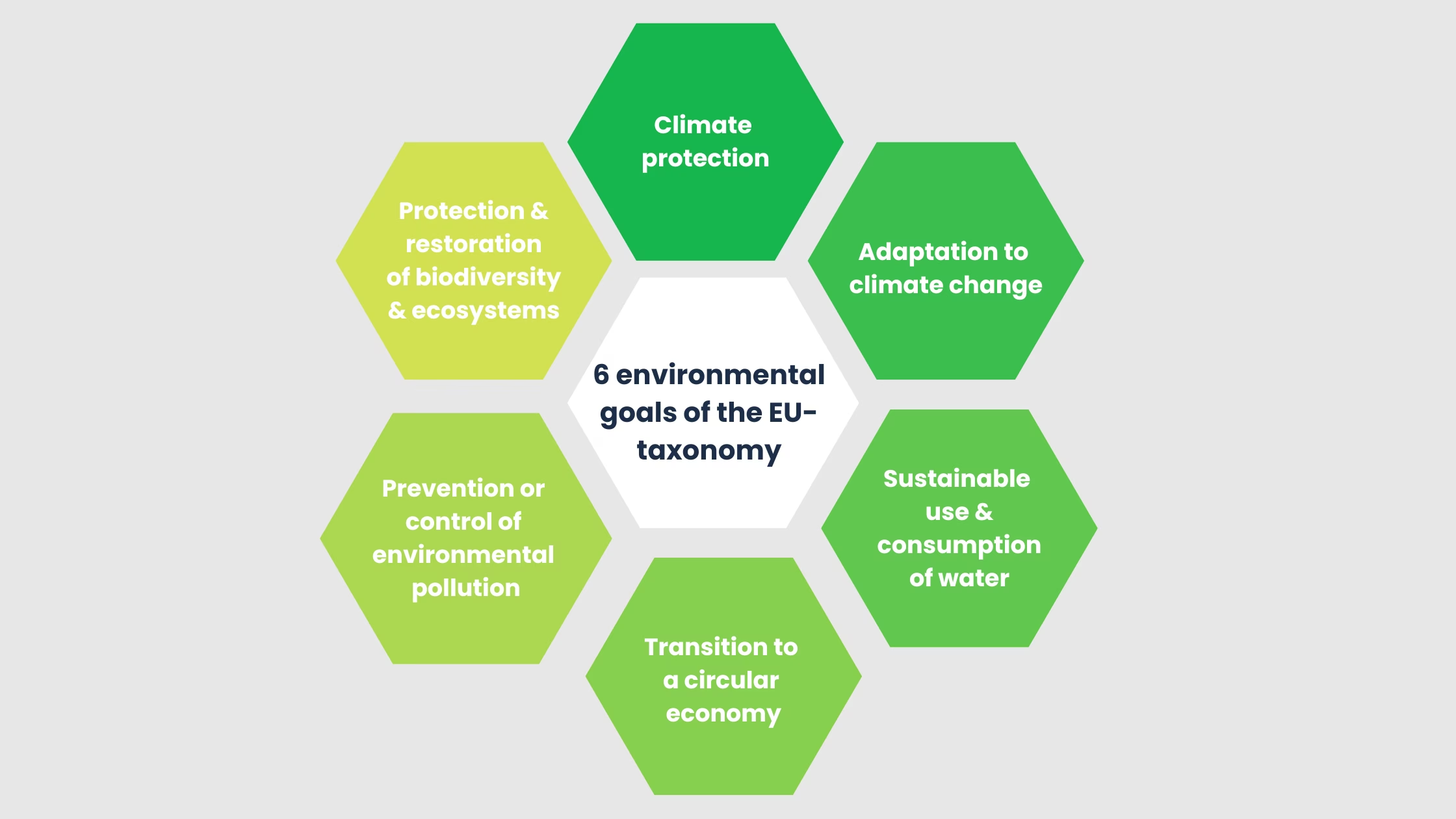
The taxonomy comprises six environmental goals, including climate protection, adaptation to climate change, circular economy, water and marine resource protection, pollution prevention and biodiversity protection.
An economic activity is considered taxonomy-compliant if it:
The requirements are complex and data-intensive, especially for companies with diverse business areas or international supply chains.
It improves the comparability of sustainability reports, supports investment decisions and is a key tool for credible ESG strategies.
The EU taxonomy is the EU-wide standardized classification system for determining which economic activities are considered environmentally sustainable. It creates a clear, verifiable definition of green and thus ensures that sustainability is not just claimed, but can be comprehensibly classified according to fixed criteria. Activities are assessed, not entire companies.
The aim of the regulation is to support the transformation in line with the European Green Deal: Capital flows should flow more strongly into activities that contribute measurably to environmental goals. At the same time, the taxonomy is intended to limit greenwashing, establish comparability and create a common frame of reference for companies, investors and member states.
In terms of content, the taxonomy is based on six environmental objectives, ranging from climate protection and adaptation to climate change to the circular economy, water, pollution prevention and biodiversity. An activity is only considered taxonomy-compliant if it makes a substantial contribution to at least one objective, does not significantly harm other objectives (DNSH), complies with minimum protection and meets the technical assessment criteria.
For affected companies, this means above all that key taxonomy figures must be disclosed, in particular on turnover, CapEx and OpEx. In practice, the timetable and the group of companies affected are closely linked to sustainability reporting (CSRD) and are currently in flux due to EU simplifications. At the same time, the application of the taxonomy itself is becoming more practical: since the beginning of 2026, new requirements have made reporting easier, including leaner templates and a 10% materiality logic that reduces the amount of checking required.
In short, the EU taxonomy is not a bureaucratic end in itself, but a standard that makes sustainability measurable and thus places reporting, financing and transformation on a common basis.
The current focus of the EU taxonomy is less on new obligations and more on noticeable simplification in application and reporting. Delegated Regulation (EU) 2026/73 (published in the Official Journal of the EU on 8 January 2026) has streamlined the disclosure requirements in several places.
What is new or has been simplified?
In addition, the EU Commission has published draft FAQs (17.12.2025) that explain the application of the changes and address typical implementation issues.
Important in practice:
These changes are particularly relevant for companies that have to report taxonomy KPIs as part of the CSRD (Corporate Sustainability Reporting Directive) anyway. This is because it is here that the decision is made as to where verification and data effort is really necessary and where companies can manage with less detail in future.
The EU taxonomy is an EU-wide standardized classification system for environmentally sustainable economic activities. It defines when an activity is considered environmentally sustainable and thus makes the term sustainable verifiable and comparable.
Essentially, the taxonomy creates a common frame of reference for companies, investors and financial market players: instead of vague sustainability promises, there are clearly defined criteria that can be used to assess whether an activity actually makes a measurable contribution to environmental goals.
In short, the EU taxonomy is a common definition of green in terms of activities, not entire companies.
With the European Green Deal, the EU has set a clear course: Europe is to become climate-neutral by 2050 and emissions are to be significantly reduced by 2030. This is not just a political goal, but above all an investment task: the conversion of energy, industry, buildings, mobility and value chains requires enormous resources. And even if public programs provide a lot of impetus, it is clear that the transformation cannot be financed on a broad scale without private investment.
This has long been a key problem: what exactly is "sustainable"? Terms such as "green", "environmentally friendly" or "sustainable" were used very differently depending on the provider, industry or country. This has encouraged two things: Greenwashing (when something appears "green" but the effect cannot be proven) and market fragmentation (when everyone evaluates according to different standards). This has made it difficult for companies and investors to classify sustainability in a comparable and verifiable way and to direct capital flows towards genuinely sustainable activities.
The EU Taxonomy Regulation was therefore adopted to create a uniform frame of reference: it defines when an economic activity is considered environmentally sustainable, not as a question of image, but on the basis of clear criteria. Together with the SFDR (for financial market players) and the sustainability reporting framework (CSRD), it forms the foundation of the EU strategy for sustainable finance.
The common effect: sustainability should not only be formulated as a goal, but also become measurable, comparable and more transparent in the market.
As a result, the regulation pursues three central guiding principles: directing capital flows more strongly towards sustainable investments, systematically anchoring sustainability in risk management and promoting long-term investments and business practices. In this way, the EU not only creates orientation, but also legal certainty and fairer competitive conditions, as all parties involved can refer to the same benchmark.
The EU taxonomy is intended to do one thing above all: make sustainability measurable and comparable in an economic context. It is therefore a key component in supporting the objectives of the Green Deal, i.e. the transformation towards a climate-neutral and resource-efficient economy. For this to work, the taxonomy pursues several interlinked objectives.
Until the taxonomy, there was no consistent answer to the question of what "green", "sustainable" or "environmentally friendly" really means within the meaning of the EU. The aim of the regulation is therefore to establish a common frame of reference that clearly describes when an economic activity is considered environmentally sustainable.
The taxonomy is intended to help channel investments more strongly into activities that make a substantial contribution to environmental goals and thus make the transformation financially viable. In short: money should flow more easily to where it has a demonstrable impact.
A key driver was the experience that "green" claims are often difficult to verify. The taxonomy counters this with clear criteria instead of advertising promises. The aim: if sustainable properties are claimed, they should be verifiable and thus strengthen trust among investors, customers and stakeholders.
Without a uniform framework, many parallel benchmarks (national, industry-related, product-related) are created. The taxonomy is intended to prevent precisely this, creating an EU-wide reference point so that sustainable activities can be compared across countries and sectors.
In addition to directing capital, it is also about the stability of decisions: Sustainability risks should not remain "optional", but should be systematically taken into account. The taxonomy supports this approach by providing a structured basis for incorporating ecological aspects into assessments and decisions.
To make it clear what "ecologically sustainable" refers to, the taxonomy works along six environmental goals:
What is important here is that an activity should not just be "somehow good", but should support sustainability without conflicting objectives, i.e. it should not improve in one place and significantly harm in another.
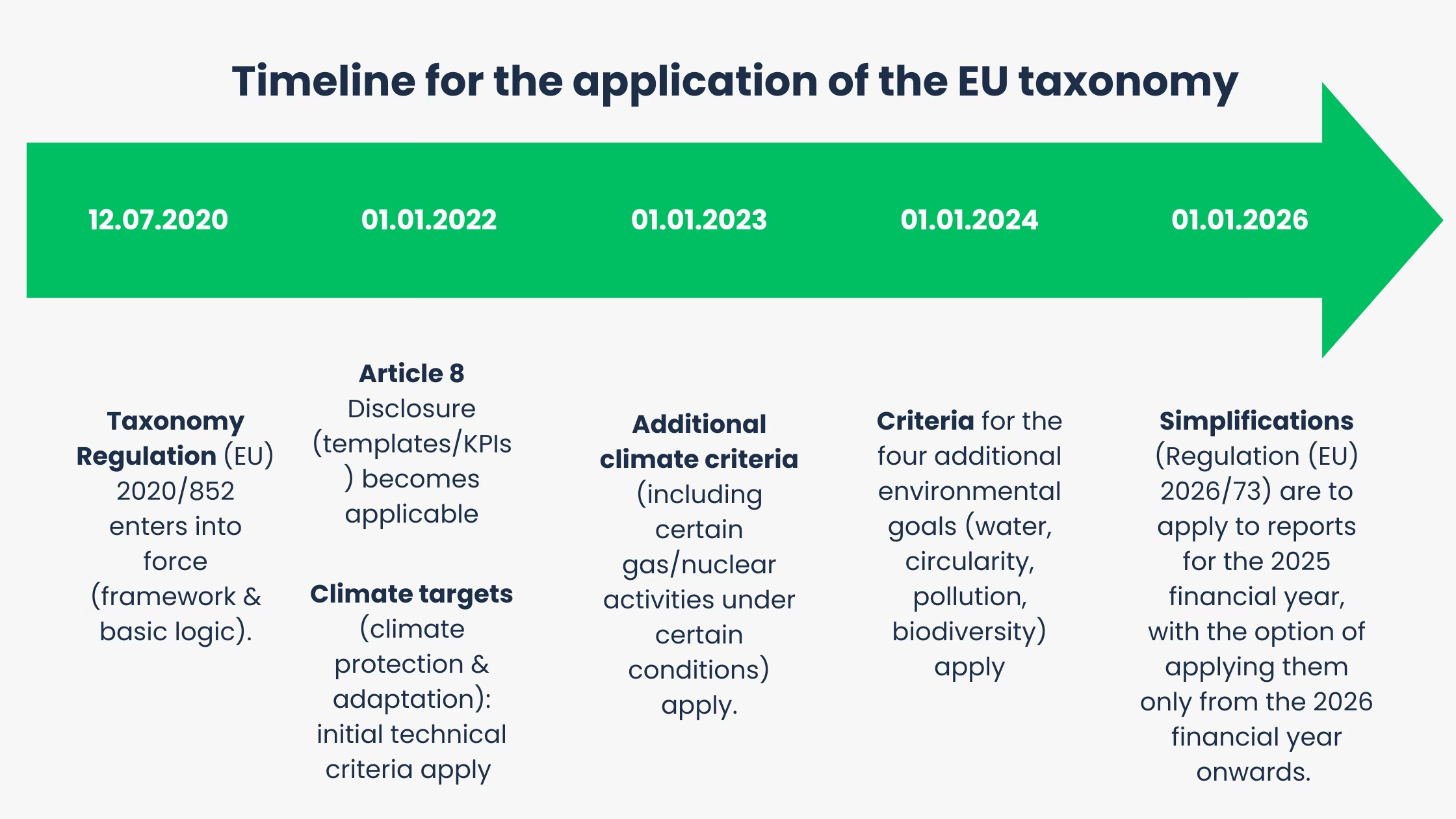
It is worth making a clear distinction in terms of timing: The taxonomy has been legally valid since 2020, but has been introduced in stages in practice (criteria + reporting) and has since been expanded and adapted via delegated acts.
The taxonomy works with technical criteria ("Technical Screening Criteria"), which were successively implemented for each target area:
In practice, taxonomy disclosure in accordance with Article 8 depends on whether a company (or group) is subject to sustainability reporting. Groups that were already subject to the previous NFRD reporting must apply the CSRD requirements for the first time for the 2024 financial year (publication of the report in 2025).
For all other large companies and listed SMEs, the start was postponed by two years as part of the "stop-the-clock" regulation: Large companies will therefore generally only start from the 2027 financial year (2028 report), listed SMEs from the 2028 financial year (2029 report). Companies are considered "large" if they exceed at least two of three criteria on two consecutive reporting dates: more than 250 employees, more than €50 million in net sales and/or more than €25 million in total assets.
Article 8 logic was also introduced in stages, first taxonomy-compliant, later taxonomy-compliant:
There have been noticeable simplifications in reporting since the beginning of 2026:
Brief note: "Who exactly" is affected remains politically in motion
In practice, taxonomy disclosure is closely linked to the group of CSRD/accounting directive reporting entities. As part of the EU simplification (omnibus), application dates were postponed (stop-the-clock) and the future limitation of the group of users was discussed or provisionally agreed, which can also indirectly influence who has to report taxonomy KPIs.
Whether a company is affected by the EU taxonomy depends less on the industry or its own sustainability claim than on whether taxonomy-related information must be disclosed. The taxonomy is therefore primarily a reporting and transparency framework: It ensures that companies and financial market players can use a uniform standard to show what proportion of their activities can be classified as environmentally sustainable.
In practice, two groups are currently particularly relevant:
It is important to note that the CSRD was originally intended to significantly expand the group of users and thus also the group of companies for which taxonomy disclosures are practically relevant. At the same time, this expansion has recently come under political and regulatory pressure. In the course of the EU simplifications (omnibus), deadlines have been postponed (stop-the-clock) and work is being done in parallel to refocus the future user group. For SMEs, this means that the question "Are we affected?" now depends more than ever on which reporting wave actually applies and how the final thresholds are structured in the simplified CSRD framework.
In short, the companies and financial market players most affected are those that have to report sustainability information and for whom the EU taxonomy provides the common logic to not only claim "environmentally sustainable", but to classify it uniformly.
Navigate safely through the requirements of the EU directive: Our tool supports you in complying with the regulation and implementing the sustainability targets.
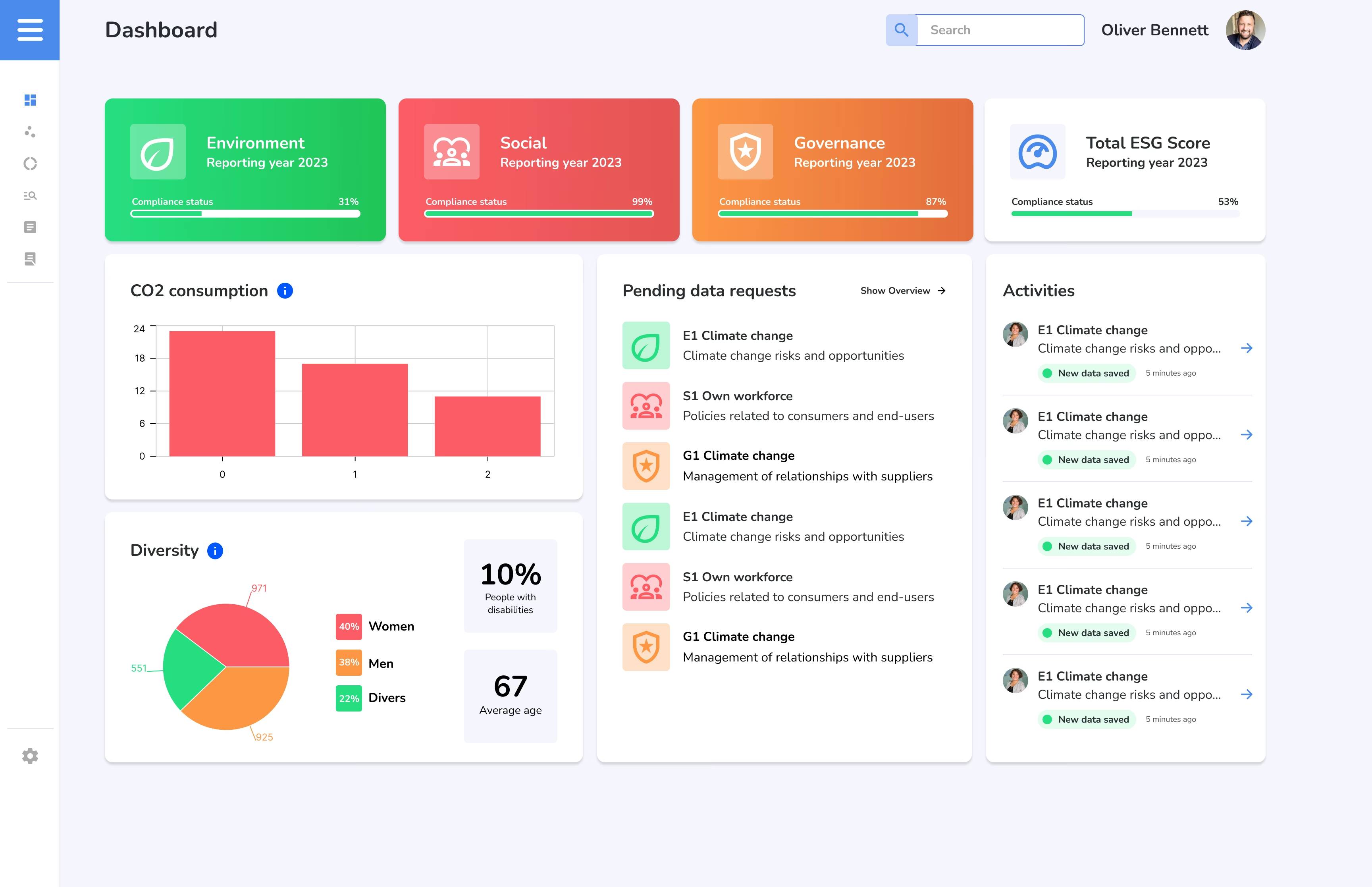
If your company is subject to the EU taxonomy disclosure, the core issue is to disclose the proportion of taxonomy-related activities in the company in a comprehensible and auditable manner. The EU taxonomy does not require a "green self-assessment", but rather a structured classification according to fixed specifications, including key figures, methodology and documentation.
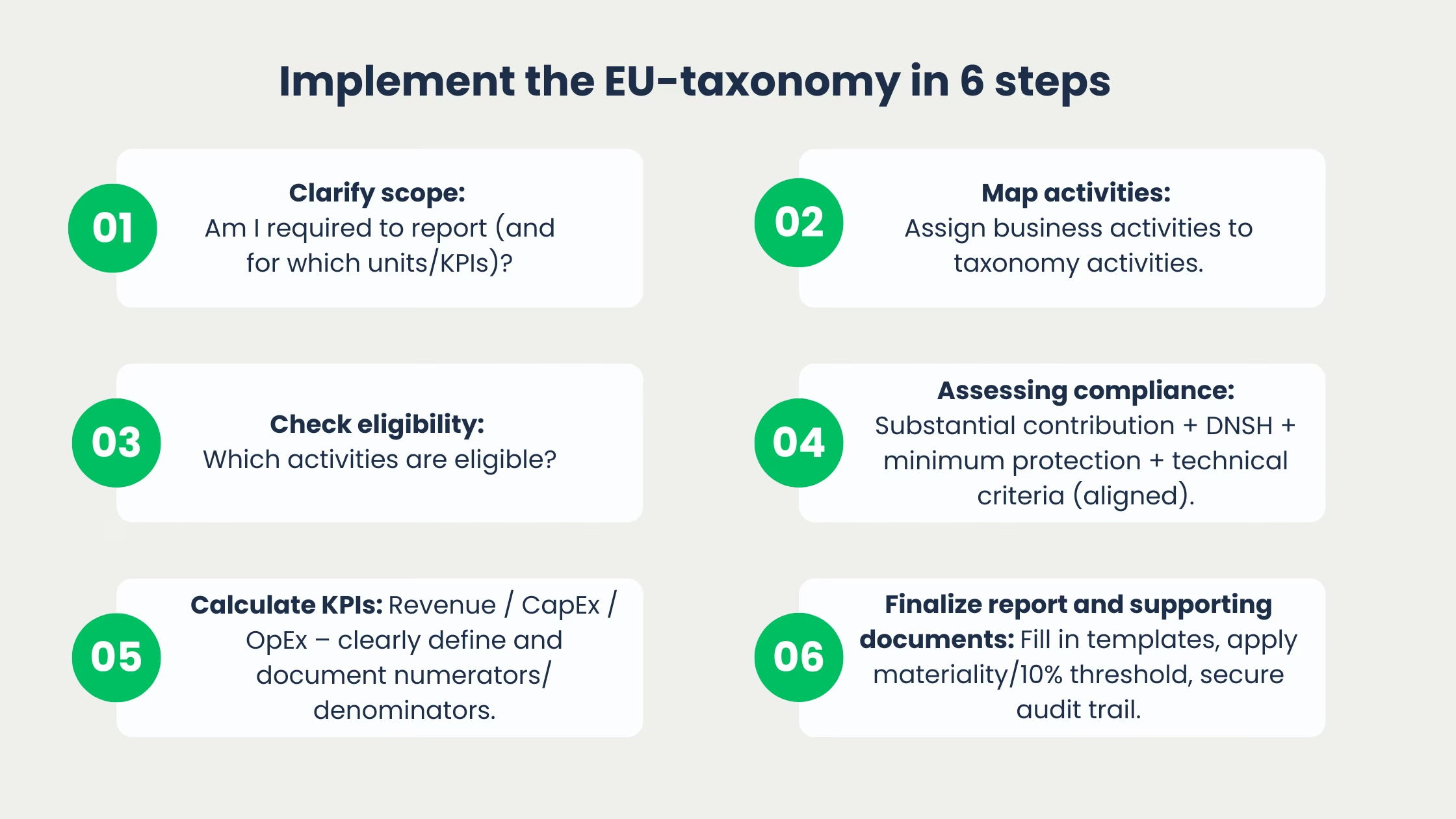
In practice, a clear process has proven itself:
For this to work properly, two things are needed above all: data capability (financial/controlling logic, clean denominators/counters, clear delimitations) and governance (who provides which evidence, who checks, who consolidates). In practice, this is precisely where most friction losses occur, because taxonomy is not just a sustainability issue, but also has a deep impact on finance, investment planning and process documentation.
New and important (as of January 2026): Delegated Regulation (EU) 2026/73 has noticeably simplified reporting and datapoints. This primarily affects companies that have previously invested a great deal of effort in detailed checks. Among other things, there is now a 10% materiality threshold (certain activities can be reported separately as "non-material" instead of being audited in full) and simplifications to the OpEx KPI if OpEx is not material to the business model. In addition, templates/data points have been reduced.
For implementation, it helps to consciously plan for these simplifications: Which activities are below the materiality threshold anyway? Where can OpEx be methodically justified? Which evidence (e.g. DNSH/minimum protection) really needs to be provided - and for which parts can you reduce the effort without losing significance?
In addition, the Commission has published draft FAQs (17.12.2025), which address typical interpretation and implementation issues relating to the amended disclosure - helpful if internal discussions (e.g. on delimitation or presentation) are stuck.
According to the EU taxonomy, an economic activity is not considered sustainable if it sounds good, but if it can be classified as ecologically sustainable according to clear criteria.
It is important to note that the taxonomy evaluates activities, not the entire company. A company can therefore have both taxonomy-compliant and non-compliant activities.
For an activity to be considered taxonomy-compliant, four conditions must be met:
In practice, a simple distinction helps to understand the logic:
It is precisely this second stage that is often the more time-consuming part, because evidence, delimitations and documentation play a central role.
CSRD, SFDR and the EU taxonomy are often mentioned in the same breath because together they create the European framework for making sustainability comparable in the market.
The three modules have different tasks:
You can think of it as a common language: Companies provide the transparency and data basis via CSRD. The taxonomy ensures that "environmentally sustainable" is not interpreted arbitrarily. And the SFDR brings this information into the financial product logic so that investors can recognize what proportion of a portfolio is actually based on activities that can be classified according to taxonomy criteria.
Mnemonic:
CSRD = reporting obligation of companies,
Taxonomy = definition/classification,
SFDR = disclosure in the financial market.
You can find out how to avoid the most common sources of error when preparing sustainability reports in our checklist.

The EU taxonomy is not a sustainability label, but a standardized reference framework that makes environmental sustainability comparable and verifiable. For companies, this means above all that the focus is not on the question "Are we sustainable?", but on which activities can be classified as environmentally sustainable according to clear criteria and how transparently this classification is presented in the report.
At the same time, the taxonomy is no longer a purely theoretical set of rules. It has an impact where sustainability influences decisions: in investments, financing discussions, tenders and in the expectations of stakeholders. Those who clearly understand the logic and embed it internally can not only reduce compliance risks, but also better explain how their own business model contributes to the transformation.
It is also currently clear that the EU is steering the taxonomy more towards practicality. With the latest simplifications, reporting and data collection are being streamlined in several places without abandoning the basic idea that sustainable activities must be documented and not just claimed. At the same time, the environment remains dynamic: in conjunction with CSRD and SFDR, the scope of application, timetables and guidance are being further developed.
The bottom line is that companies should not treat the EU taxonomy as a one-off project, but as a recurring standard process with clear responsibilities, robust data logic and documentation that can withstand scrutiny and further development. Those who set this up properly at an early stage will create long-term security, comparability and room for maneuver.
The taxonomy is an EU classification system that defines which economic activities are considered sustainable. It aims to promote investment in environmentally friendly technologies and create transparency for companies and investors. The taxonomy defines six environmental goals, including climate protection and the transition to a circular economy. An activity is classified as sustainable if it makes a significant contribution to at least one of these goals, does not significantly harm any other goal and complies with minimum social standards. Since January 2022, large companies have been obliged to disclose the sustainability of their activities in accordance with the regulation.
It was introduced to create a standardized classification system for environmentally sustainable economic activities. This is intended to promote transparency, steer investment towards environmentally friendly projects and prevent greenwashing. It is a central instrument of the EU action plan for financing sustainable growth and supports the objectives of the European Green Deal, in particular climate neutrality by 2050.
The regulation currently mainly affects large, capital market-oriented companies with more than 500 employees and financial market participants that offer financial products in the EU. However, the introduction of the Corporate Sustainability Reporting Directive (CSRD) will significantly expand the group of companies subject to reporting requirements. From the 2025 financial year, all large companies that meet at least two of the following criteria will be required to report: more than 250 employees, a balance sheet total of more than 20 million euros or net revenue of more than 40 million euros. From the 2026 financial year, capital market-oriented small and medium-sized enterprises (SMEs) will also be included in the reporting obligation. This gradual expansion means that a large number of companies of different sizes and from different sectors will have to meet the requirements in future.
The main objective of the taxonomy is to channel capital flows into sustainable investments in order to achieve climate neutrality in the EU by 2050. To this end, it defines six environmental goals: Climate change mitigation, climate change adaptation, sustainable use and protection of water and marine resources, transition to a circular economy, pollution prevention and reduction, and protection and restoration of biodiversity and ecosystems. By providing clear criteria for sustainable activities, the taxonomy aims to create transparency, prevent greenwashing and enable investors to make informed decisions.
It stipulates that an economic activity is considered environmentally sustainable if it fulfills four key criteria:
Compliance with these criteria is intended to ensure that activities classified as sustainable actually make a positive contribution to environmental goals without compromising other goals, while at the same time respecting social standards.
In their non-financial reporting, companies must disclose the proportion of their revenue, capital expenditure (CapEx) and operating expenditure (OpEx) that is associated with taxonomy-compliant economic activities. To do this, they first identify taxonomy-compliant activities and then check their conformity with the taxonomy's technical assessment criteria.
The regulation is primarily aimed at large, capital market-oriented companies that are already obliged to provide non-financial reporting. However, with the introduction of the CSRD, the group of companies required to report will be expanded. From the 2025 financial year, all large companies that meet certain criteria will be required to report, and from 2026, capital market-oriented small and medium-sized enterprises (SMEs) will also be included.
Although not all SMEs are required to report directly, they may be affected indirectly. For example, banks and investors may require information from them in order to assess the sustainability of their own portfolios. It therefore makes sense for SMEs to familiarize themselves with the requirements and align their business models accordingly in order to meet future requirements and ensure their competitiveness.
The taxonomy obliges financial institutions to disclose the sustainability of their financial products by indicating the extent to which their investments and financing meet the taxonomy criteria. A key instrument here is the Green Asset Ratio (GAR), which measures the proportion of taxonomy-compliant assets in a financial institution's portfolio. This disclosure is intended to channel capital flows into sustainable projects and requires financial institutions to adapt their investment strategies and internal processes in order to meet the new requirements. The taxonomy also increases transparency for investors, enables well-founded decisions and promotes the development of sustainable financial products.
These include the generation of renewable energies such as wind and solar energy, measures to increase energy efficiency, for example through building renovations, as well as activities in the area of the circular economy that support recycling and resource conservation. Sustainable forestry and environmentally friendly transportation, such as low-emission vehicles, are also classified as sustainable. This classification is intended to create transparency and help achieve the EU's climate targets.
To implement the taxonomy in your company, you should first check whether your company is obliged to report. Then identify relevant business activities, assess their compliance with the criteria and ensure compliance with minimum social standards. Collect the necessary data and integrate it into your reporting to ensure transparency about the sustainability of your activities.
The application poses challenges for companies. These include legal ambiguities and contradictory criteria that make implementation difficult. In addition, there is often a lack of complete data for the required reporting, which increases the workload. Integrating the requirements into existing company processes requires considerable adjustments and can be resource-intensive. These factors highlight the need for clear guidelines and supporting measures to ensure the successful implementation of the EU taxonomy in companies.
The taxonomy is a classification system that sets out clear criteria for defining economic activities as environmentally sustainable. It differs from other sustainability standards and ratings in that it is legally binding and focuses on scientifically based, uniform benchmarks. In contrast to voluntary standards such as the Global Reporting Initiative (GRI) or the Carbon Disclosure Project (CDP), which provide companies with guidelines for sustainability reporting, the taxonomy prescribes specific requirements that companies must meet. It also aims to provide investors with a reliable basis for sustainable investment decisions and to prevent greenwashing. The combination with guidelines such as the CSRD and the Sustainable Finance Disclosure Regulation (SFDR) creates a comprehensive framework that promotes transparency and comparability in sustainability reporting within the EU.
Environmental organizations such as Greenpeace and BUND have filed lawsuits with the European Court of Justice to stop the classification of gas and nuclear power as sustainable, as they fear that this decision contradicts the EU's climate targets. In addition, financial supervisory authorities and banks criticize the complexity and lack of practical relevance of the taxonomy, which could overburden companies and mainly favor consulting firms. Studies also show that the existing reports according to the EU taxonomy are often not very meaningful, which makes it difficult to assess the actual sustainability of companies.

 DE
DE