EUDR - Reading time: 10 Min
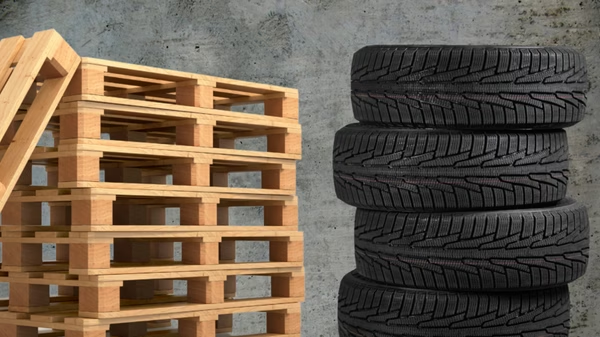
Since the EU Deforestation Regulation (EUDR) came into force, companies that trade in wood, rubber or their products have faced new challenges - especially when dealing with used goods. While the debate has so far focused on new products, the status of second-hand items such as truck tires or wooden pallets is increasingly causing uncertainty: do they also have to comply with the EUDR requirements? This article clarifies how the EUDR classifies used goods and when the regulation applies to used products. It also provides practical tips for companies when dealing with these goods.
No. If a product, e.g. a tire or a pallet, was already lawfully placed on the EU internal market before June 29, 2023 or before, a new EUDR test is not required, even for resale, rental or export within the EU.
If it is subsequently significantly modified, e.g. by replacing load-bearing wooden parts on pallets or retreading tires with new natural rubber. Then it can be considered a "new product" and is again subject to the EUDR duty of care.
A modification is considered significant if it fundamentally changes the material composition or function of the product. Minor repairs, cleaning or testing do not count as such, but extensive modifications or upcycling do.
A complete collection of information on product launch and use is recommended, e.g. date of purchase, proof of origin, serial numbers, delivery receipts or maintenance history.
No. Used goods that have already been properly placed on the EU internal market can generally be exported from the EU without a new EUDR test - provided they have not been significantly modified.
In addition to documentation, clear communication along the supply chain is crucial - for example through clear product labeling and indication of the used status in invoices, delivery bills or digital systems.
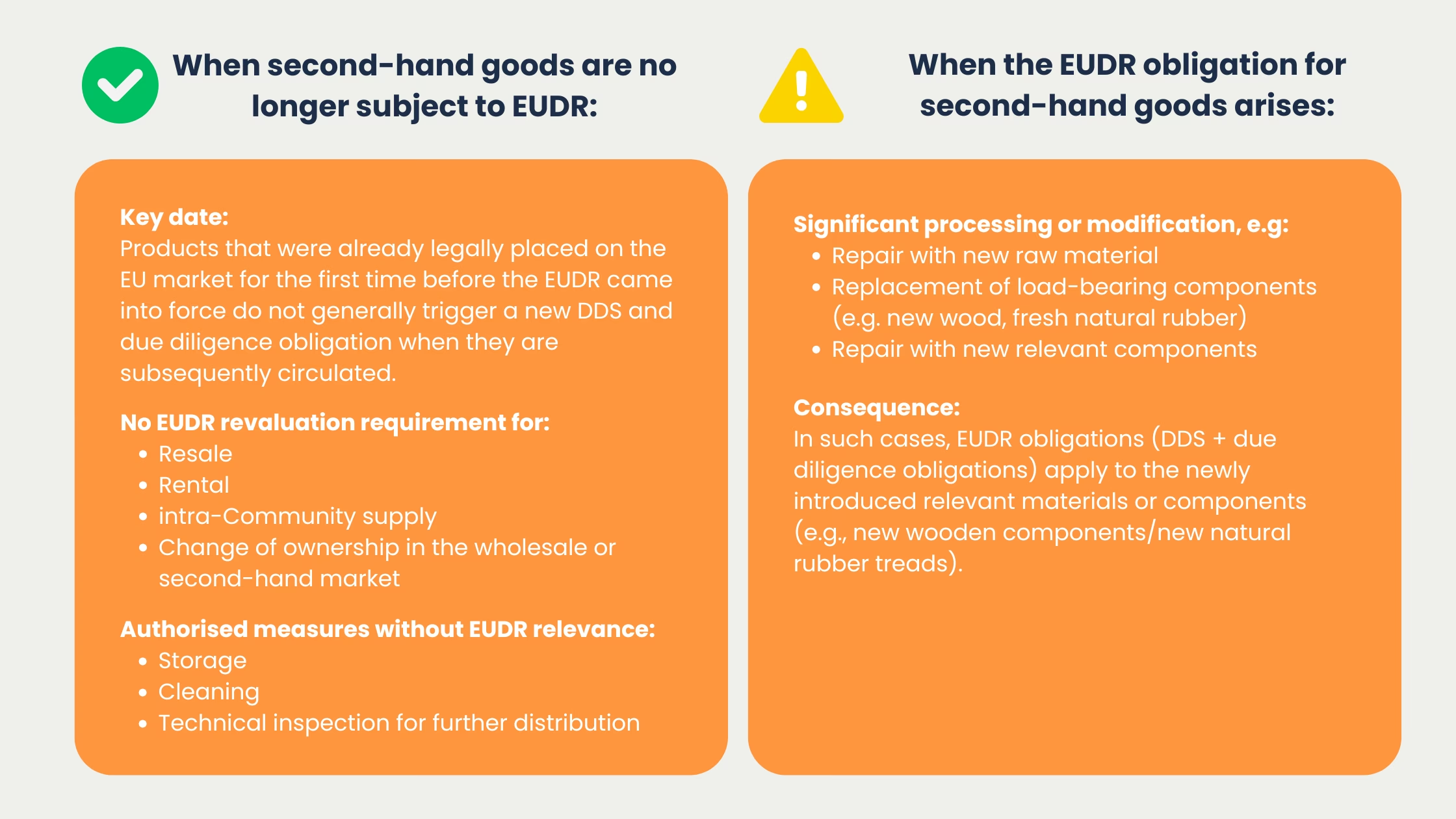
The EU Deforestation Regulation (EUDR ) obliges companies to prove the legal and deforestation-free origin of certain raw materials, such as wood, cocoa, coffee and natural rubber, before products made from them are placed on the EU internal market for the first time. Since the amending regulation, a special distinction has to be made between market participants and downstream market participants/traders for the transfer in the supply chain: The latter generally do not submit a due diligence declaration (DDS), but must maintain certain information; non-SMEs must register in the EU information system. For used goods, such as tires or pallets, this does not generally apply if the goods were already lawfully made available on the Union market before the respective date of application; in addition, relevant products produced before 29 June 2023 are not covered under Art. 1(2). Even in the case of resales, rentals or intra-Community transfers, no re-examination is generally required, provided that no new initial making available takes place. However, the prerequisite for this is that the products have not been significantly modified since then.
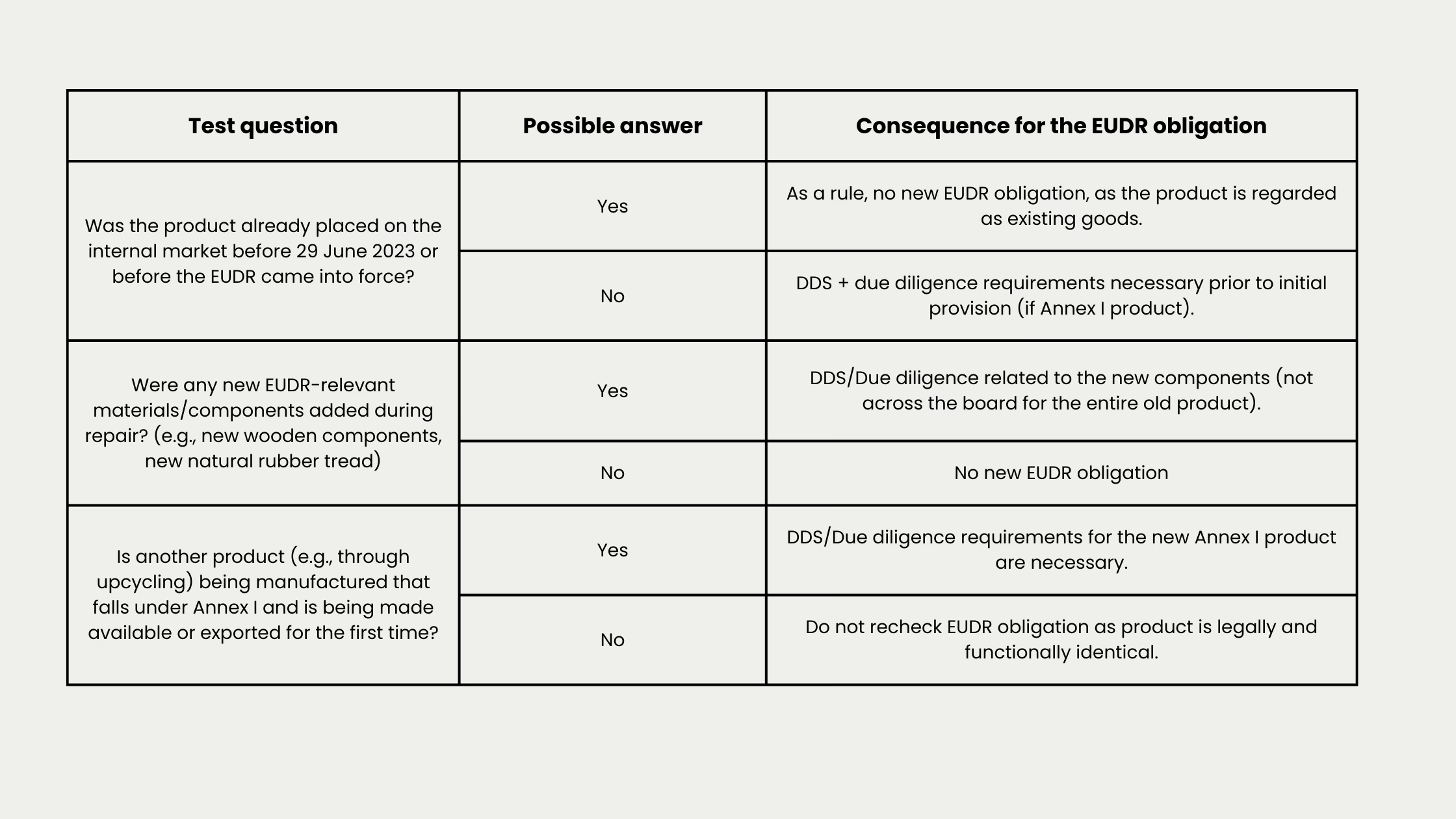
A significant change occurs when new, EUDR-relevant materials are introduced. This can be the case, for example, when replacing load-bearing wooden elements on pallets or when retreading tires with fresh natural rubber.
If new EUDR-relevant material is introduced during repair/refurbishment (e.g. new wooden components for pallets or new natural rubber components for retreaded tires), the EUDR obligations typically relate to these newly added components. Companies should therefore attach importance to proper documentation of the original product introduction and use. This includes evidence of the initial purchase, the origin, any maintenance steps or serial numbers. If available, the reference number of the due diligence declaration (or - in the case of simplified declarations - an identification number) should be documented. The obligation to record the reference number applies in particular to the first downstream market participant or retailer in the chain. Clear communication along the supply chain is equally important in order to clearly label new and used goods and avoid misunderstandings. This effectively minimizes regulatory risks when dealing with second-hand products.
Trade in used goods has a long tradition in Europe and is becoming increasingly important due to the scarcity of resources and sustainability goals. Products such as tires, containers or transport pallets in particular regularly go through several usage cycles. Uncertainty is now arising in the wake of the EUDR: Does the same duty of care apply to any resale or export of a used good as to new goods? Many companies are confronted with inventories for which only incomplete preliminary information is available - especially if products entered the EU years ago.
This uncertainty is omnipresent in the supply chain. On the one hand, there is often a lack of transparency as to when exactly a product was "placed on the market" for the first time. On the other hand, there are many different constellations in practice: Products are repaired, refurbished or supplemented with new parts and then resold. While the regulation primarily addresses the direct origin of raw materials, the question arises as to whether and when used goods are considered "new" products within the meaning of the EUDR.
The aim of the Deforestation Regulation ( EUDR for short) is to keep products with a risk of deforestation and forest degradation out of the European internal market as far as possible. This includes not only raw materials such as soya, coffee, palm oil, cattle or wood, but also products made from these, such as furniture, paper products or tires made from natural rubber. Essentially, the regulation requires that only deforestation-free products may be marketed, sold or exported within the EU. Companies must rely on verifiable evidence to prove that their products are deforestation-free.
As a rule, companies are obliged to carry out a comprehensive due diligence and risk analysis. This includes the traceability of the origin of raw materials, compliance with local laws and the submission of due diligence declarations as well as the submission of comprehensive verification documents. The due diligence obligation applies both to new products and to processed or composite articles that are associated with the relevant products - provided they are placed on the Union market for the first time.
A central element of the EUDR is the term "placing on the market". According to the content of Article 2 No. 16 of the Regulation, this means: "any first making available of a relevant product on the Union market for distribution or use." The decisive factor is therefore when a product - be it a raw material, an individual part or a finished product - is made available on the market for the first time within the scope of the Regulation. If a product was already imported in compliance with the law before the EUDR came into force or elsewhere in the internal market, it is deemed to have been "placed on the market". Such goods do not have to be tested again. Furthermore, second-hand is only expressly excluded from the scope of application if the product has completed its life cycle and would otherwise be disposed of as waste.
Subsequent changes of ownership, resale, rental or storage within the EU do not generally trigger a new first making available if the product has already been lawfully placed on the market in the EU. However, if a used product is imported into the EU from a third country for the first time after the start of use, this may constitute making available for the first time.
Update legal status (Amendment Ordinance 12/2025):
The Regulation now explicitly distinguishes between market participants and downstream market participants (obligations such as traders). Traders and downstream operators do not transmit DDSs and do not generally have to ensure that due diligence obligations are met. However, non-SMEs among them must register in the EU information system and may only trade/provide/export relevant products if they fulfill the prescribed information and retention obligations.
In practice, this means that products that were "placed on the market" in an EU member state before the EUDR came into force (from 30.12.2026 or 30.06.2027 for micro/small enterprises) are not subject to a new EUDR test, even if they are resold, rented or exported. This applies analogously if a product changes from buyer to buyer, for example in wholesale, second-hand business or cross-border trade from country to country within the EU.
The decisive factor is whether a significant processing or treatment step has taken place in the meantime. If the product is merely stored, cleaned or tested for resale, it remains a "used" product from an EUDR perspective. Only if new relevant materials or components are added in the course of repair or reprocessing (e.g. new wood or new natural rubber) can EUDR obligations arise for these newly introduced components. Pure cleaning, testing, sorting or resale reconditioning without new relevant components generally leaves the product with the status 'already placed on the market' from an EUDR perspective.
Tires consist to a large extent of natural rubber, which is explicitly listed as risk-relevant in Annex I of the EUDR. According to estimates by the International Rubber Study Group, the annual global production of natural rubber amounts to around 14 million tons - the majority of which is harvested in Asia. According to a study by the Vrije University of Amsterdam, five percent of the natural rubber produced worldwide is used for tires for European vehicles - primarily for car tires. As forests were deliberately cleared for many plantation areas, the EU explicitly classifies tires as subject to EUDR if they are sold in the EU for the first time.
New tire importers must therefore ensure that both the rubber material obtained and the production process can be documented as deforestation-free and legal in accordance with the EUDR. The verification requirements are considerable: in addition to proof of the country of origin, traceability to the parcel of land on which the rubber was grown is also required.
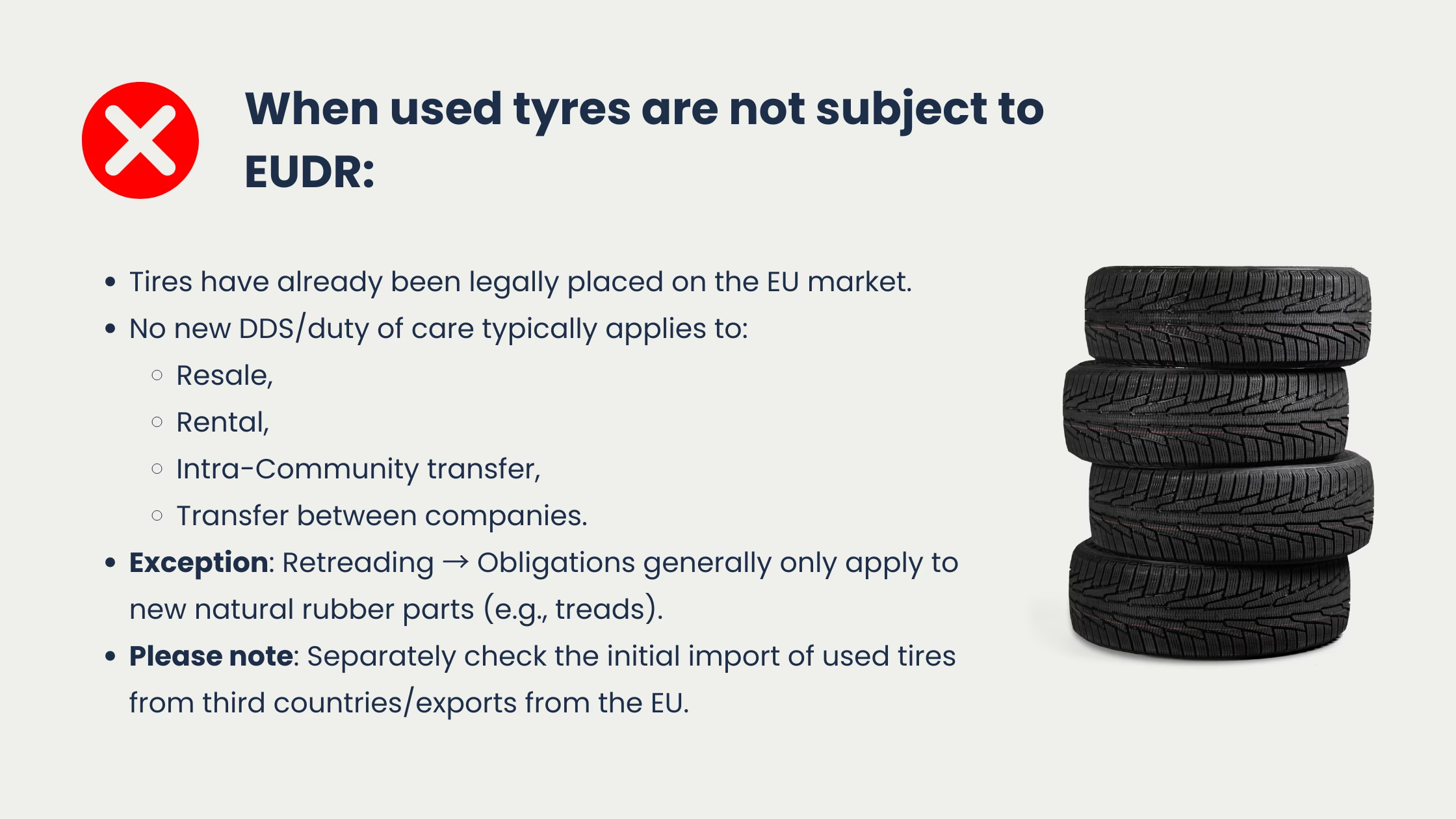
When reselling used tires within the EU, there is generally no new "initial" provision if the tires have already been lawfully placed on the market in the EU. According to the Commission's clarification, the following applies to retreaded tires: EUDR obligations only apply to the newly added natural rubber components (e.g. new tread), while casings/carcasses as such are outside the scope.
A typical example: A truck fleet renews its tires after three years and sells the tires to a second-hand dealer or to other European countries. As the tires have already been imported and taxed as a new product, the goods are treated as "used" in every subsequent trade transaction and are no longer subject to compliance from an EUDR perspective. This exemption also applies to tires that are exported within the EU or transferred between companies, as long as no further processing has taken place.
However, if a used tire is imported into the EU from a third country for the first time after the start of application, this may constitute a first-time supply, in which case the obligations apply in principle.
However, retreaded tires are handled differently. Here, the worn tire substructure ("carcass") is reconditioned, vulcanized and provided with a new tread layer. According to the Commission's updated FAQ clarification, used carcasses and casings are generally outside the scope of application, while retreaded tires are only covered to the extent that new natural rubber components (e.g. new tread, tread) are added. Accordingly, due diligence obligations and DDS refer to these new natural rubber parts, not to the entire carcass.
For the EUDR classification, it is not so much a general 'materiality criterion' from customs law that is decisive, but rather the question of whether and which new relevant natural rubber components are introduced during retreading and subsequently placed on the market as a retreaded tire. In this case, the EUDR obligations apply to these new natural rubber components. If only a minor repair is carried out without significantly changing the identity of the tire, it remains classified as used goods. However, if extensive retreading or reconstruction is carried out, the tire is considered a new product and is therefore subject to EUDR. A detailed examination of each individual case is therefore required.
Wood products play a central role in the context of the EUDR, as raw wood is a potential driver of global deforestation and is one of the relevant raw materials covered by the regulation. Transport pallets, in particular the widely used Euro pallets, are made of various types of wood and are produced, exchanged and reused in Europe by the millions. The majority of pallets circulating in the EU originate from domestic or European production. Nevertheless, some pallets from non-European sources, such as Asia or South America, are also used, which can be traced back to deliveries or disposable packaging.
The full EUDR due diligence obligation therefore applies to new pallets, regardless of whether they are exchangeable or disposable. Manufacturers and importers must prove the legal and deforestation-free origin of the wood during production by means of suitable documents and declarations before the pallets can be sold or passed on in the EU.
Note: Pallets (CN/HS 4415) are not in scope as packaging materials if they are used exclusively to carry, protect or support other goods. Pallets are particularly relevant to EUDR if they are placed on the market or exported as an independent product (e.g. empty pallets/packaging as merchandise).
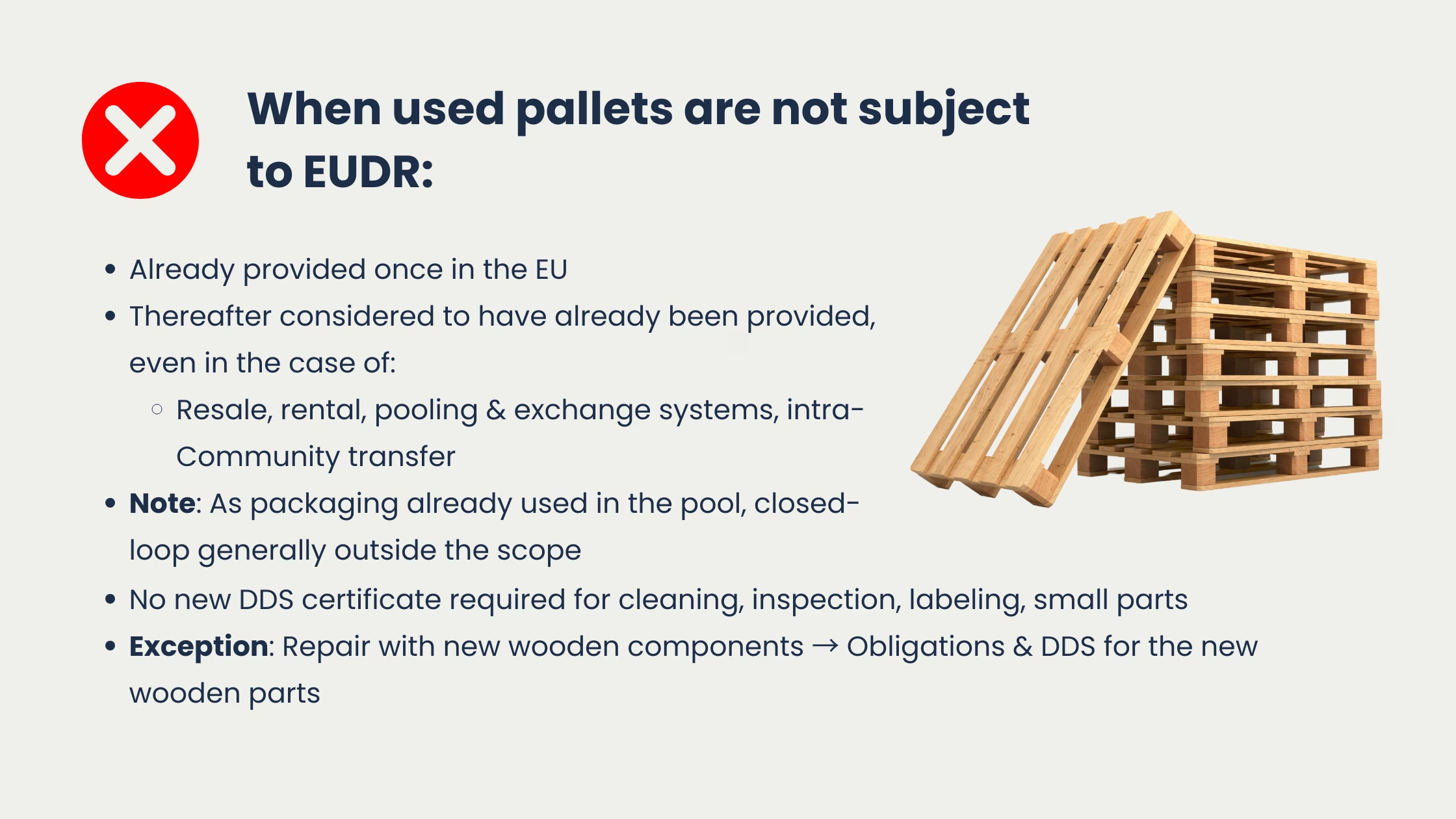
Once pallets have been made available as a finished product on the EU internal market, for example by a European manufacturer or an importer, they are considered to have been "placed on the market". With this introduction into the internal market, they are considered used packaging when subsequently traded, rented, exchanged or passed on within the EU and, according to the FAQ and guidance clarification, are outside the scope of application as long as they have already been used once to carry, protect or support other goods and no new relevant wood components are introduced.
This applies in particular to the widespread exchange networks such as the open Euro pallet pool, in which millions of pallets have been in circulation for decades. Customs and inspectors also recognize that no new EUDR due diligence obligation arises for pallets that have already been introduced into the economic cycle in Europe as long as no changes are made to the essential components of the pallet. This applies in particular to exchange/closed-loop systems (e.g. pallet pools): According to the Commission FAQ, empty, already used packaging in circulation is not in scope.
If a used pallet is merely cleaned, checked, marked or pooled, it continues to be traded as a component part of an existing product. However, if wooden components are replaced (e.g. board, strip), the FAQ clarification states that the EUDR obligations apply to these new wooden components. In this case, a DDS must be submitted for the repaired pallet, whereby the due diligence only includes the new wooden parts.
Nevertheless, there are exceptions:
Repairs are EUDR-relevant if new timber components are introduced (e.g. replacement of deck or supporting boards). A DDS is then required, but the due diligence only relates to the new wood components. Pure processing without new wood parts (cleaning, sorting, marking) remains outside the scope.
In the case of upcycling, it must also be checked whether the new product even falls under a CN heading listed in Annex I; only then do EUDR obligations arise.
A detailed examination of the individual case is recommended here: If the modification is only carried out to restore the original functionality, without any substantial addition of material, it can still be legally considered a used pallet. However, if new raw materials are added on a larger scale and the product is given a new function or identity as a result of the modification, the EUDR testing obligation applies again. This means that commercial upcycling providers in particular need to take action.
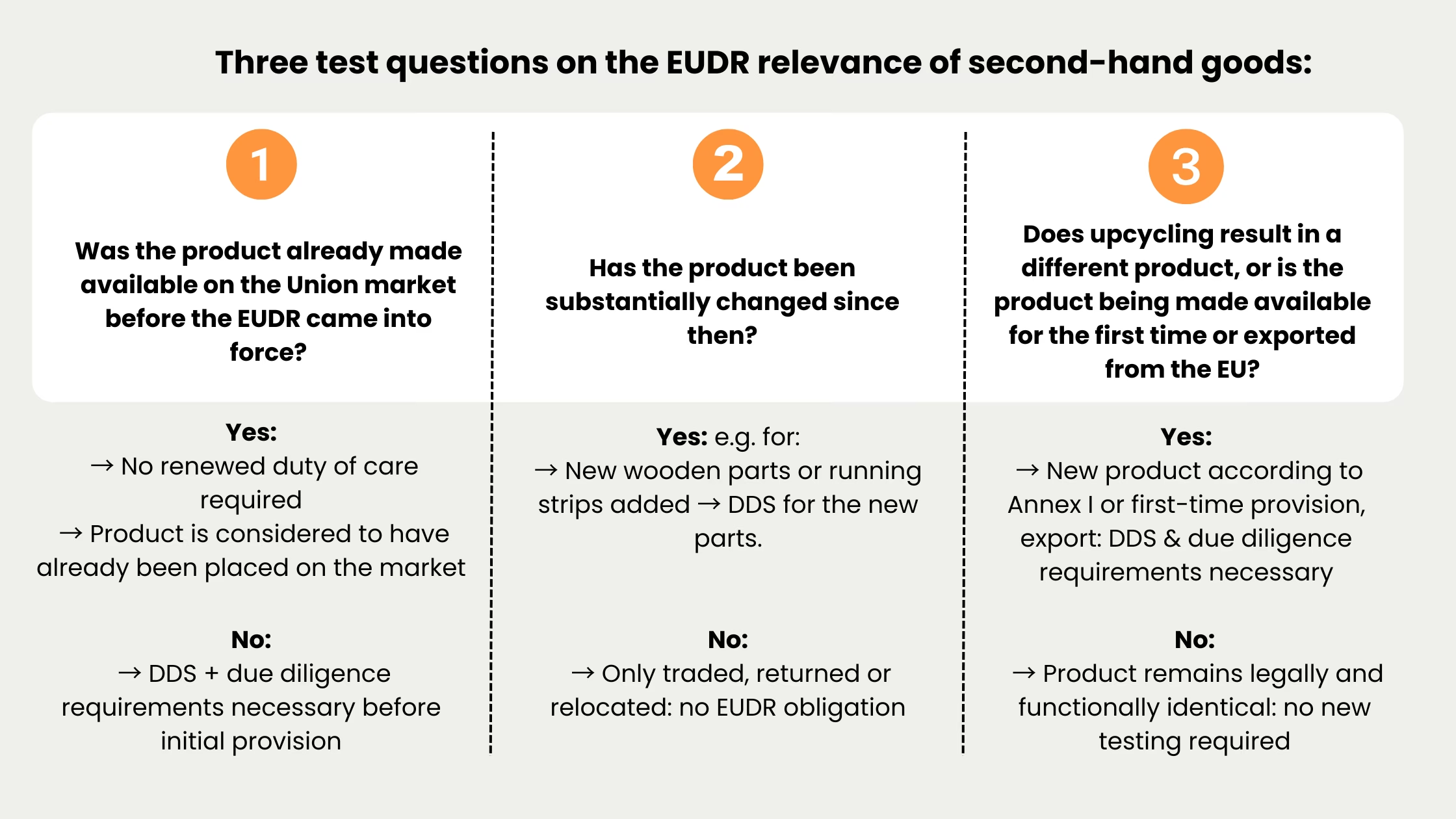
Three key questions determine whether and how the EUDR applies to second-hand goods.
Used goods (e.g. tires or pallets) are generally not subject to a new EUDR test if the product was already lawfully made available on the Union market before the EUDR came into force and is merely resold, rented out or kept in circulation. It is important to note that there is no blanket exemption simply because of a production date before June 29, 2023. Rather, transitional rules apply to certain timber and timber products that were produced before June 29, 2023 and fell within the scope of the former EU Timber Regulation (EUTR): If such products are placed on the market from December 30, 2026, the classification will in principle continue to run via the EUTR regime until December 31, 2029; from December 31, 2029, they must then meet the EUDR criteria in accordance with Article 3. It also remains crucial that no significant change has taken place - in particular, no new relevant materials (e.g. new wood components or new natural rubber components) may have been introduced in the course of repair/refurbishment, otherwise obligations arise in relation to these newly added components.
Large, medium-sized and small companies that trade in used goods such as tires or pallets should attach importance to complete documentation of product introduction and use. It is particularly important to document the reference number of the due diligence declaration or identification number (in the case of simplified declarations) - especially where you are the first downstream market participant/trader to take over the goods from an upstream stage - and to keep the documents for at least five years. The collection of reference and identification numbers is primarily necessary for the first downstream operator, not for all of them. This collection of information includes details such as the date and proof of first purchase, the unique origin from the EU internal market, any existing serial numbers or proof of delivery as well as descriptions of previous use and any maintenance steps. The creation of a central register in which this product information is stored has already proven its worth in practice. In this way, gaps in evidence can be minimized even years later and official inquiries can be answered quickly.
Clean communication along the entire supply chain is just as important. Companies should clearly indicate to suppliers and downstream business partners at an early stage whether they are dealing with new or used items. This can be done as part of invoicing, in delivery bills or technical product descriptions. For EUDR-relevant processes, DDS reference numbers (verification numbers if necessary) should also be linked per batch/transaction in the ERP and on the accompanying documents so that the chain remains traceable. Clear product identification is also useful, for example through barcode tags, labeling or entries in the digital merchandise management system. This is the only way to avoid queries and misunderstandings.
Borderline cases such as retreaded tires, repaired pallets with replacement boards or industrially refurbished components should be subjected to an in-depth inspection at an early stage. In particular, companies that specialize in "refurbishing", upcycling or the series repair of industrial goods must clearly document which new EUDR-relevant materials/components have been introduced (e.g. new wooden components, new natural rubber treads) - because the obligations in such cases are linked to these new relevant components. If in doubt, specialist or legal advice should be sought in good time. It may also be advisable to contact local authorities or customs if there is uncertainty about the classification of individual production steps.
As a result, used products such as tires or pallets generally do not trigger a new EUDR due diligence obligation or a new DDS if they have already been lawfully made available on the Union market and are merely resold, rented or kept in circulation. However, companies should not rely on this across the board - especially if new EUDR-relevant materials/components are added in the course of repair, refurbishment or conversion (e.g. new wooden components or a new natural rubber tread). In such cases, the requirements typically apply to these new components. A reliable product and process classification (incl. differentiation between "packaging in circulation" vs. "independent commercial goods"), complete documentation and - where relevant - the linking of processes with the reference number of the due diligence declaration or an identification number and the provision of evidence for at least five years are crucial for legal certainty.
Compliance officers and product managers should align their processes in such a way that EUDR-relevant processes are identified at an early stage and the necessary evidence can be retrieved at any time.
Significant changes are processing steps that change the fundamental identity of the product - for example, by adding new raw materials (e.g. new wood for pallets or fresh rubber for tires) or converting to a different product type. As a rule, this does not include mere cleaning or maintenance.
No, a minor repair - such as repairing minor damage without using new raw material - does not change the status of the tire. It remains exempt from the EUDR as used goods. A complete retread, on the other hand, may require a new assessment in individual cases.
No, used goods that have already been placed on the market within the EU can generally be exported without a new EUDR check - as long as they have not been significantly modified or reassembled since then. When exporting, the reference/identification numbers must always be provided to the customs authorities. However, this does not apply to exports by downstream market participants.
Careful documentation of previous use, precise classification of used products and transparent communication along the supply chain can largely prevent unwanted compliance risks.
Yes, the greater the proportion of new, EUDR-relevant material in the remanufacturing of a product, the more likely it is to be classified as a new product and therefore subject to EUDR. Used products without substantial material additions are generally exempt.

 DE
DE