EUDR - Reading time: 8 Min
The responsible use of raw materials along the global supply and processing chains is becoming increasingly important as a result of the European Union's Green Deal. Since 2023, the European Regulation on the Prevention of Deforestation (EUDR) has been at the heart of this. This legal obligation affects not only traditional commodity traders or importers of wood and soy from agriculture, but also more and more companies from the paper and healthcare industries. After all, these companies place paper products, hygiene articles such as disposable aprons and other end products containing wood on the market. The question of the extent to which paper products and processed products are subject to notification under the EUDR is currently one of the most discussed topics in the area of compliance and supply chain management. This technical article examines the requirements of the EUDR for paper products and disposable aprons in all their complexity. In focus: Which raw materials are affected, how does the processing chain play a role, what significance do CN items have and what do the European Commission's FAQs say? The article offers companies an analysis and recommendations for action in order to implement reporting obligations in a legally compliant manner and minimize risks in the supply chain.
Yes, paper products and disposable medical articles such as disposable aprons are subject to EUDR if they are made of wood and fulfill the relevant CN headings.
The relevant CN headings for paper products are Chapters 47 (pulp), 48 (paper and paperboard) and 4818 (sanitary articles).
Yes, as long as the end product is assigned to a listed CN heading, regardless of the processing steps.
Hybrid products may be subject to EUDR as long as they are classified as paper-based products for customs purposes.
No, the obligation to declare does not lapse as a result of processing or finishing, but remains in force as long as the CN heading is recorded.
The EUDR not only affects traditional commodity traders, but increasingly also companies in the paper and healthcare industry that place paper products and disposable items such as disposable aprons on the market. The key question is to what extent these products will remain subject to notification under the EUDR - an issue that is particularly relevant for compliance and supply chain management.
The EUDR lists seven primary raw materials(including wood) and products made from them as relevant for the reporting obligation. The decisive factor here is the tariff classification according to the Combined Nomenclature (CN). For paper products, the CN headings of chapters 47 (pulp), 48 (paper and paperboard) and 4818 (hygiene articles, e.g. disposable aprons) are particularly relevant. Paper-based products, including disposable medical aprons, fall under the EUDR if they are assigned to these product groups.
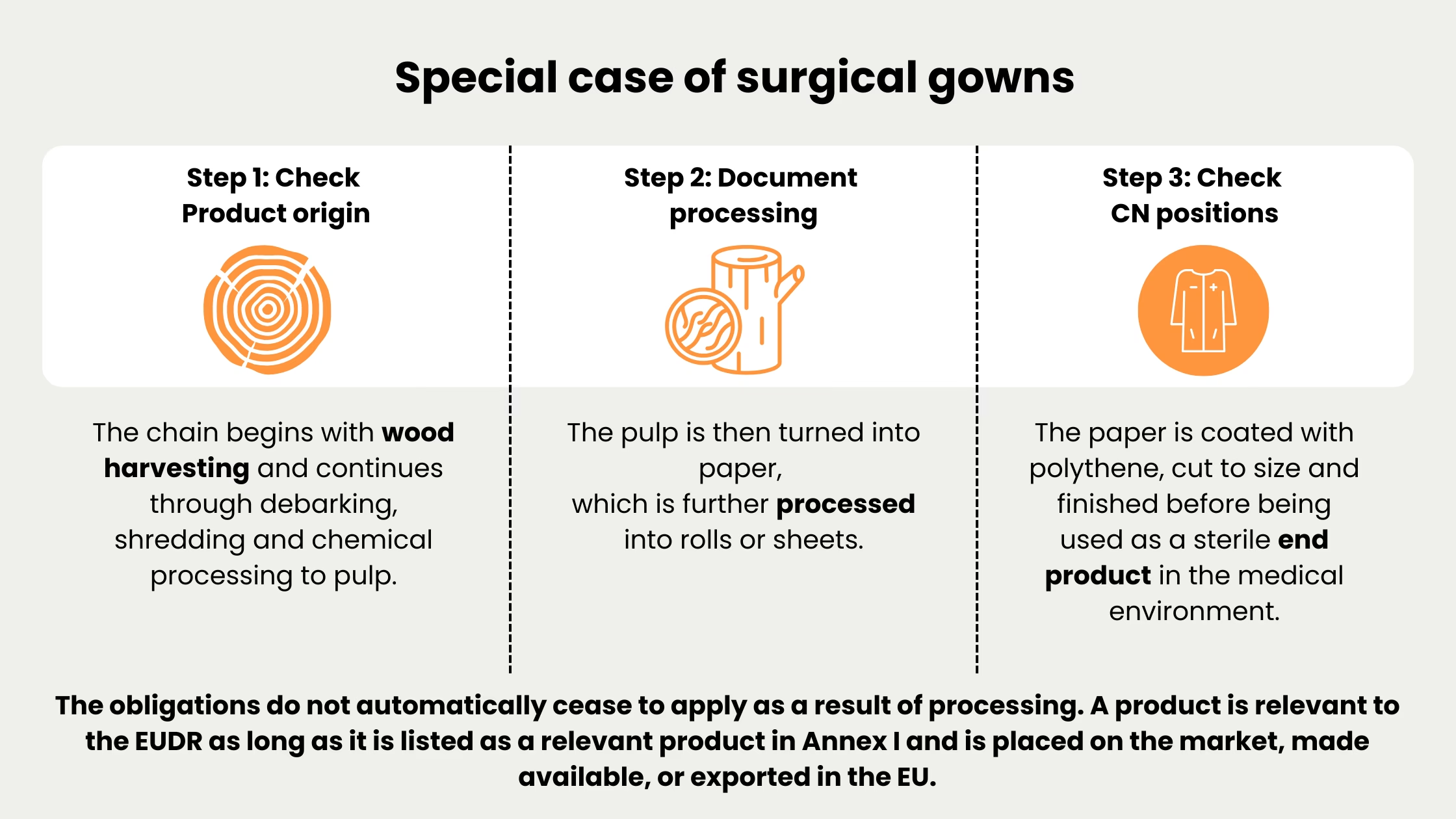
The decisive factor is whether the respective intermediate or end product is classified as an Annex I product. Processing can therefore result in a product remaining in scope or falling out of scope - depending on the resulting CN/HS code. Processing steps - such as the production of pulp, paper and further processing into disposable aprons - do not automatically lead to the elimination of the obligation to declare. The customs CN heading of the end product is decisive. Even in the case of complex hybrid products, the EUDR relevance remains as long as the product is assigned to one of the listed product groups. This applies regardless of the number and type of processing steps. Exceptions only exist if it can be proven that the product no longer falls under an EUDR-relevant CN heading.
Current FAQ documents from the EU Commission emphasize that it is not technical processing steps, but exclusively the CN position that determines the EUDR reporting obligation. Companies must therefore carry out an EUDR due diligence process for all paper-based products and disposable items such as disposable aprons, ensure complete documentation of the supply chain and prove that the wood used is legal and deforestation-free. Traceability back to the area of origin. For micro and small primary producers in low-risk countries, it is permissible to provide the address instead of geolocation.
Recommendations for companies
EUDR compliance along the entire supply chain remains a key issue for companies in the paper and healthcare industry. The reporting obligation does not cease to apply as a result of technical processing, but remains in place until the product is clearly classified according to CN heading. Proactive management of product classification, documentation and internal processes is essential in order to avoid regulatory risks and fines. The dynamic development of the EUDR makes it necessary to continuously maintain knowledge and use official guidelines and industry standards in order to implement the requirements in a legally compliant and efficient manner.
The EUDR (EU Deforestation Regulation, Regulation (EU) 2023/1115) explicitly links its obligations to certain raw materials and products made from them. It requires that only deforestation-free products enter the European market. Annex I of the regulation lists seven primary raw materials: Beef, cocoa, coffee, palm oil, soy, rubber and wood. Only those products are relevant to EUDR that are listed in Annex I via specific CN headings and that are placed on the market/prepared in the EU or exported from the EU. Wood in particular is a central focus, as an enormous range of end products is created from it.
Wood is at the heart of most paper-based supply chains and the packaging industry. The industrial manufacture of modern paper products is predominantly based on the processing of pulp, which in turn is obtained from wood. According to a report by DIE PAPIERINDUSTRIE e.V., around 23 million tons of paper, cardboard and paperboard were produced in Germany in 2021. A significant proportion of this was based on virgin fiber wood, supplemented by waste paper as a secondary raw material. The output stage covered by the Deforestation Ordinance concerns both raw wood and further processed semi-finished materials such as pulp (CN 4703), paper and cardboard (CN 4801-4823) and special materials for disposable medical products (CN 4818 (incl. certain subheadings, depending on product specification)). The delimitation and continued obligation to declare EUDR is particularly relevant for these further processing operations.
Latex gloves, absorbent pads and surgical material, for example, are also subject to EUDR. Latex gloves and absorbent pads are among the most frequently used products in the medical sector. As they are generally made of natural rubber or cellulose (wood), they are subject to the Deforestation Regulation. The same applies to some disposable products used in operating theaters. Companies that trade in, manufacture, import or export these products are very likely to fall under the EUDR Regulation. Here too, the prerequisite applies that the products are covered by an Annex I CN heading, e.g. in the context of ex 4015 for gloves or 4818 for hygiene articles.
How the product is coded in the customs tariff is central to the applicability of the EUDR. The Combined Nomenclature (CN) lists the relevant product groups and sub-groups with numerical codes. The regulation refers to these CN headings in order to create clarity in the classification of the reporting obligation. In contrast to the technical understanding of processing steps, the customs classification is therefore decisive. For paper products, the EUDR CN headings of chapters 47 (pulp), 48 (paper and paperboard) and in particular 4818 (including hygiene articles such as paper towels and toilet paper) are decisive. Depending on the material composition, disposable aprons can also fall under paper-based product groups covered by the EUDR.
Particularly in view of ongoing technical innovations and material specifications, tricky classification issues can arise in day-to-day business. The CN heading determines whether or not an EUDR due diligence procedure applies to a product and, accordingly, whether or not a reporting obligation under the Deforestation Regulation applies.
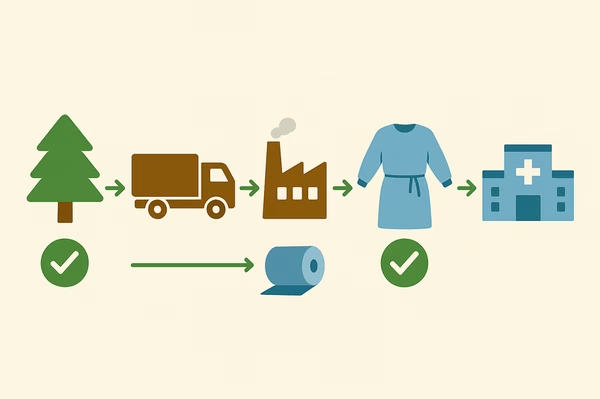
If you look at the classic development of a tree through to a disposable apron in a clinic, the scope of the regulation quickly becomes clear: the chain begins with the harvesting of wood (e.g. from sustainable forestry) and continues through debarking, shredding and chemical processing to pulp. This is then turned into paper, which is further processed into rolls or sheets. In the production of disposable aprons, the paper is coated with polyethylene, cut to size and finished before it is used as a sterile end product in the medical environment.
Each of these processing steps changes the material structure, but this does not necessarily mean that the EUDR reporting obligations no longer apply. On the contrary, the decisive factor is whether the respective product (or the product resulting after processing) falls under a CN/HS heading listed in Annex I. Processing can therefore result in a product falling into or out of scope - depending on how it is classified for customs purposes. For imported end products in particular, it requires companies to be able to provide complete documentation of their purchased preliminary products.
A key uncertainty for many companies is whether and to what extent the EUDR requirements still apply to highly processed products. Let's take the disposable apron as an example: If the apron consists mainly of paper/pulp and is classified under an Annex I heading (e.g. in the area of Chapter 48/4818, depending on the ex scope), it remains EUDR-relevant and is subject to the reporting obligation in terms of the EUDR due diligence process, regardless of how many processing steps the source material has already undergone. The specific CN classification should be confirmed by means of (binding) tariff information in the event of uncertainty.
Even hybrid products made of paper and plastic, for example, can be subject to EUDR as long as the product labeling (tariff classification) indicates this. The decisive factor is not the (perceived) wood content, but the tariff classification and whether the specific product is included in Annex I. For companies, this means In case of doubt, a thorough look at the CN table is no substitute for a technical gut feeling - and the difference between paper and plastic aprons can be essential from a compliance point of view.
The main lesson to be learned from the EUDR system and the accompanying interpretations of the EU Commission is that the obligation to declare does not automatically cease as a result of processing or technical change of the originating raw material. Rather, every product remains EUDR-relevant as long as its CN heading is listed in the Annex to the EUDR. This also means that paper, pulp and paper products made from them, such as disposable aprons, disposable towels or packaging products, will continue to be treated as EUDR-relevant, regardless of complex processes and possible refinement.
Exceptions may apply if goods are treated as waste within the meaning of EU waste legislation. The following applies to upcycling: The decisive factor remains whether the newly created product falls under an Annex I CN item.
Downstream market participants and traders generally do not submit due diligence declarations, but must fulfill information and retention obligations. Non-SMEs must register in the information system and take action if there are justified concerns.
With increasing uncertainty in practice, the European Commission published extensive FAQ documents on the EUDR in 2024 and early 2025. The clarification is particularly important for the paper sector: the technical processing steps or the degree of processing are not decisive for the reporting obligation of a product. It is also decisive whether the product is classified as an Annex I product at the time it is placed on the market, made available or exported.
Many companies previously assumed that with sufficient processing and added value - for example in the production of coated disposable aprons - the responsibility for the raw material trace would end. It is now clear: as long as the end product corresponds to an "EUDR-KN item", the compliance and reporting obligation remains in place. Conversely, if further processing results in a product that is not listed in Annex I, this new product is not EUDR-relevant, even if it contains a listed raw material.
In practice, this often means that downstream actors use the reference number of the due diligence declaration or identification number (for simplified declarations) from the upstream stage, but must - depending on their role and company size - fulfill the information and possibly their own DDS obligations.
This clarification puts a stop to a misleading practice in which companies rely on technical arguments such as chemical changes, structural loss of the wood or offcuts of recycled content. Ultimately, EUDR relevance is always and exclusively determined by the CN classification for customs purposes. For paper products, cellulose and all hygiene articles derived from them, it is therefore important to classify them precisely in the customs tariff system.
Traditionally, for example, pulp obtained from wood for the manufacture of disposable medical textiles is classified under CN 4818. Even if additional plastic layers are processed, the product remains EUDR-relevant as long as the main product content and the CN classification require this. Particularly in the case of complex composite products, a careful look at the applicable CN heading is essential. In the event of uncertainty, binding tariff information (BTI/BTI) creates legal certainty. It is generally valid throughout the EU.
What are the consequences of these FAQ clarifications for companies that import or process paper products or disposable aprons? This clarifies the scope of the obligations and reduces misconceptions in practice. Companies must also carry out a valid EUDR due diligence process for processed paper products and disposable items made from them, such as aprons, gloves or packaging. The legality and deforestation-free status of the wood must be confirmed when the source material is supplied. Every processor must document the evidence along the entire value chain. In other words, traceability back to the plot of land must be guaranteed. Reliable internal processes are the only way to avoid fines and delivery stops.
For companies that manufacture, trade or import products made from paper, pulp or other EUDR-relevant raw materials, a systematic relevance check is essential. Contrary to what many supply chain managers previously assumed, the due diligence obligation does not automatically end with further processing. Processing does not automatically end the obligations. The decisive factor remains whether the (intermediate/final) product continues to fall under a CN heading listed in Annex I; otherwise, it may also fall out of scope. The relevant question within the meaning of the EUDR is always: Under which CN heading does my product fall at the time of import, placing on the market, making available or export?
For example, anyone who purchases and resells coated disposable aprons (e.g. made of paper and polyethylene, typically under CN 4818) remains subject to the reporting obligation even if the product has been given a "completely different face". Legally compliant processes therefore require complete documentation of the entire processing chain - and ideally digital proof of delivery that goes back to the origin of the wood or pulp. In operational terms, this often means that downstream players work with the DDS reference and verification numbers from the EU information system instead of 'just' collecting PDFs.
In case of doubt, binding tariff information should be obtained to confirm the correct CN heading. Companies are well advised to check their technical data sheets, goods descriptions and delivery documents for EUDR conformity at an early stage.
Technical, logistics and legal departments must work closely together - because the classification of the product, the import process and the documentation require cross-departmental cooperation. In addition to pure product development, the purchasing, sales, supply chain management and customs departments in particular should be involved in checking and managing EUDR-relevant obligations.
Training and awareness-raising measures for employees in the area of product classification and materials science are recommended in view of the complexity of the regulation. A standard process for the EUDR relevance check is particularly useful for new product launches to ensure timely internal coordination and avoid misunderstandings.
The EUDR stipulates a comprehensive documentation and reporting obligation, whereby proof of origin and care must be provided along the entire supply chain. This concerns both the product composition (including all paper or pulp qualities used) and, where applicable, information on the geographical origin of the wood and the sustainable management of the forest areas.
For paper products and disposable aprons, for example, this may include supplier confirmations, import or customs data, batch and quantity references and, where applicable, proof of certification. Certificates (FSC/PEFC) are supportive, but do not replace the EUDR evidence (in particular geo-data/risk assessment depending on the case).
In the event of a dispute, companies must plausibly demonstrate that every processing step has been documented. Forward-looking and efficient management of obligations, for example through powerful software solutions, is therefore not a luxury but a necessity in order to avoid the threat of penalties and reputational risks.
In summary, it can be said that companies must systematically ensure their EUDR compliance along the supply chain when manufacturing, trading and importing paper-based products. The decisive factor here is not the technical degree of processing, but whether the respective (intermediate or end) product is classified as an Annex I product for customs purposes and is placed on the market/prepared in the EU or exported from the EU.
Companies are well advised to ensure that their product databases, goods descriptions, customs classification and distribution channels are EUDR-compliant. With a view to the application from December 30, 2026 (large and medium-sized companies) and June 30, 2027 (micro and small companies), a robust classification and documentation system is becoming increasingly important.
For ongoing updates, companies should regularly refer to the EU Commission's guidance/FAQs, information provided by the BLE, sectoral guidelines (e.g. CEPI) as well as IHK training courses and specialized customs and sustainability advice. It is also practically important to use the EU information system (DDS incl. reference and verification numbers) for the efficient, audit-proof transfer of evidence in the supply chain.
Almost all paper products classified under Chapter 48 of the CN headings fall under the EUDR reporting obligation across all sectors. This includes copying and printing paper, cardboard, tissue paper, paper bags, labels, napkins and also disposable medical products such as aprons and gloves, provided they are predominantly made of paper. The exact EUDR relevance ultimately always depends on the applicable CN heading of the product.
Yes, as long as the disposable apron is made of paper material and is therefore classified under a CN heading listed in EUDR Annex I, the EUDR declaration obligation applies. Even after further processing, such as coating with plastic film, the proof of origin of the wood and the full duty of care and documentation remain in place. However, this only applies as long as the customs description does not change to a product group exempt from EUDR.
The EUDR declaration obligation does not apply if the end product can no longer be classified under any of the CN headings listed in Annex I. This may be the case, for example, if it has been completely processed into a plastic product or if it is classified in a chapter that is not covered. However, technical processing steps alone are no guarantee that the obligation no longer applies. In case of doubt, the valid CN classification is decisive, not the technical condition of the material.
Companies that do not fulfill their EUDR obligations risk severe sanctions. These range from administrative offense proceedings to high fines and criminal prosecution. There is also the threat of import bans, product recalls and considerable reputational damage. Compliance with EUDR paper products and adherence to CN positions should therefore be a top priority.
In the event of uncertainties regarding CN classification, it is advisable to obtain binding tariff information from the national customs authorities. This provides a legally secure basis for compliance and reduces the risk of misclassification. Consultations with specialized customs lawyers can also help to correctly carry out complex product classifications and establish suitable due diligence processes.

 DE
DE